

Dog and Cat Management
The District Council of Elliston recognises that pets are a very important part of our everyday life.
As companions, they fulfil a vital role in society by providing friendship and unconditional love for their owners.
A large percentage of dogs in our District are working dogs. Working dogs provide an important role in farm life.
Elliston Council is committed to supporting responsible pet ownership throughout the community.
Whether you're a dog or cat owner, this section provides information about the management of pets in our District.
Registering your dog or cat is a legal requirement and an important part of responsible pet ownership. All dogs over three months old must be registered within 14 days of taking possession the animal.
You can register your dog by visiting Dogs and Cats Online. There are easy reference guides on the Dog and Cat Management Board’s website if you need help.
Once registered you will receive a registration certificate and a grey plastic disc with your dog’s registration number. Attach this disc to your dog’s collar. You only receive a disc once as your dog’s registration number stays with it for life. You may choose to engrave the registration number on a permanent metal disc with your name and phone number.
Registration is valid until 30 June each year. Renewal notices are issued in July and must be paid by 31 August. Please note that you cannot renew your registration until you have received your renewal notice.
If you require assistance registering your cat or dog, please feel free to contact the Council on 8687 9177 or in person at the Council Office.
Registration Fees
Council charges an annual registration fee for dogs:
- Standard Dog (microchipped and desexed) - $40.00
- Any other dog - $80.00
- Working livestock dog (microchipped) - $20.00
- Disc replacement - As per DACO charge
- Assistance dogs Free
- Cats Free
- Late Registration Renewal Fee $15.00
Concession card holders are eligible for a 50% discounted registration fee.
The penalty for not registering your dog or cat is a $170.00 expiation fee.
Registration Transfers
If your dog or cat goes to a new home, their registration must be transferred to the new owner. You’ll need to initiate a transfer in Dogs and Cats Online and give the transfer number to the new owner who then logs in to complete the transfer themselves. There are easy reference guides on the Dog and Cat Management Board’s website if you need help or call the Council for assistance.
Responsible Ownership - Owning a dog is a long-term commitment that comes with important responsibilities. As a dog owner, you are legally and ethically responsible for your dog’s behaviour at all times.
This means ensuring your dog is well cared for, properly trained, and does not pose a risk to people, other animals, or the community. Responsible ownership includes:
> Providing proper food, shelter, exercise, and veterinary care
> Ensuring your dog is registered and identifiable
> Training and socialising your dog so it behaves appropriately in different situations
> Preventing your dog from roaming or escaping your property
> Keeping your dog restrained and under effective control in public spaces
> Being aware of your dog’s temperament and removing it from situations where it may feel stressed, threatened, or overwhelmed
Good dog owners understand their dog’s needs and limitations. They take proactive steps to prevent problems rather than reacting after something goes wrong.
Remember — your dog’s behaviour reflects your responsibility as its owner.
Dog Restraints and Effective Control - Dog owners are responsible for ensuring their dog is restrained and under effective control at all times.
This means your dog must:
> Be on a leash in public places unless in a designated off-leash area
> Respond reliably to your commands
> Remain close to you and not approach people or other animals without permission
> Be physically restrained or contained when required
> Even in off-leash areas, your dog must still be under effective control. If you cannot control your dog’s behaviour, it must be leashed immediately.
Allowing a dog to roam freely or behave unpredictably puts others at risk and may result in penalties.
All cats must registered in Dogs and Cats Online. Cat registrations are free, but a late registration renewal fee may apply. Like dogs, cats must be microchipped and desexed too! Your cat’s microchip number should be provided to you by your vet, microchip implanter, shelter or breeder. If you don’t have a record of the microchip number, contact the vet, breeder or shelter where you bought or adopted it. You can also ask us about our scanning and microchipping service.
Cats make great pets and wonderful companions.
All cats must be registered in the District Council of Elliston, with their details recorded in dogsandcatsonline.com.au
Registration for cats is FREE!! (a renewal late fee may apply). An annual renewal is required to keep our registrar details up to date. Registration assists in the management of cats in our District.
As a cat owner, you are responsible for the animal’s health and wellbeing and you also have responsibilities which can impact on your community and environment.
As a cat owner you must:
- Have your cat desexed and microchipped (unless exempt)
- Make sure your cat isn’t a nuisance.
Owning or keeping an unregistered cat may attract an expiation of $170.00.
As awareness of our impacts on the environment and native wildlife continues to grow, so too does our interest and desire for better cat management. Gone are the days of keeping a cat to “keep the mice down”.
You can only keep 2 dogs or 2 cats on your property. If you wish to keep more, you must seek council’s approval. An Application for Permit to Keep more than Two Dogs or Cats must be submitted to Council.
Dog By-Law No. 5 and Cat By-Law No. 7 can be found also on this website and set's out further regulations on dog and cat control in the District Council of Elliston.
Council's Dog and Cat Management Plan outlines the strategies used to promote responsible pet ownership within the District. Whilst ensuring the needs of animals and their owners are accommodated, Council recognises the differing needs of non pet owners.
It’s important you keep your details in Dogs and Cats Online up-to-date. If you move, you should update your address in Dogs and Cats Online. If your dog or cat dies, is missing for more than 72 hours, is given to a new owner, or is surrendered to the RSPCA or Animal Welfare League, you must notify council or update the record on your Dogs and Cats Online account. Choose ‘deceased’ or ‘lost’ from the ‘Animal Status’ drop-down menu on your pet’s record.
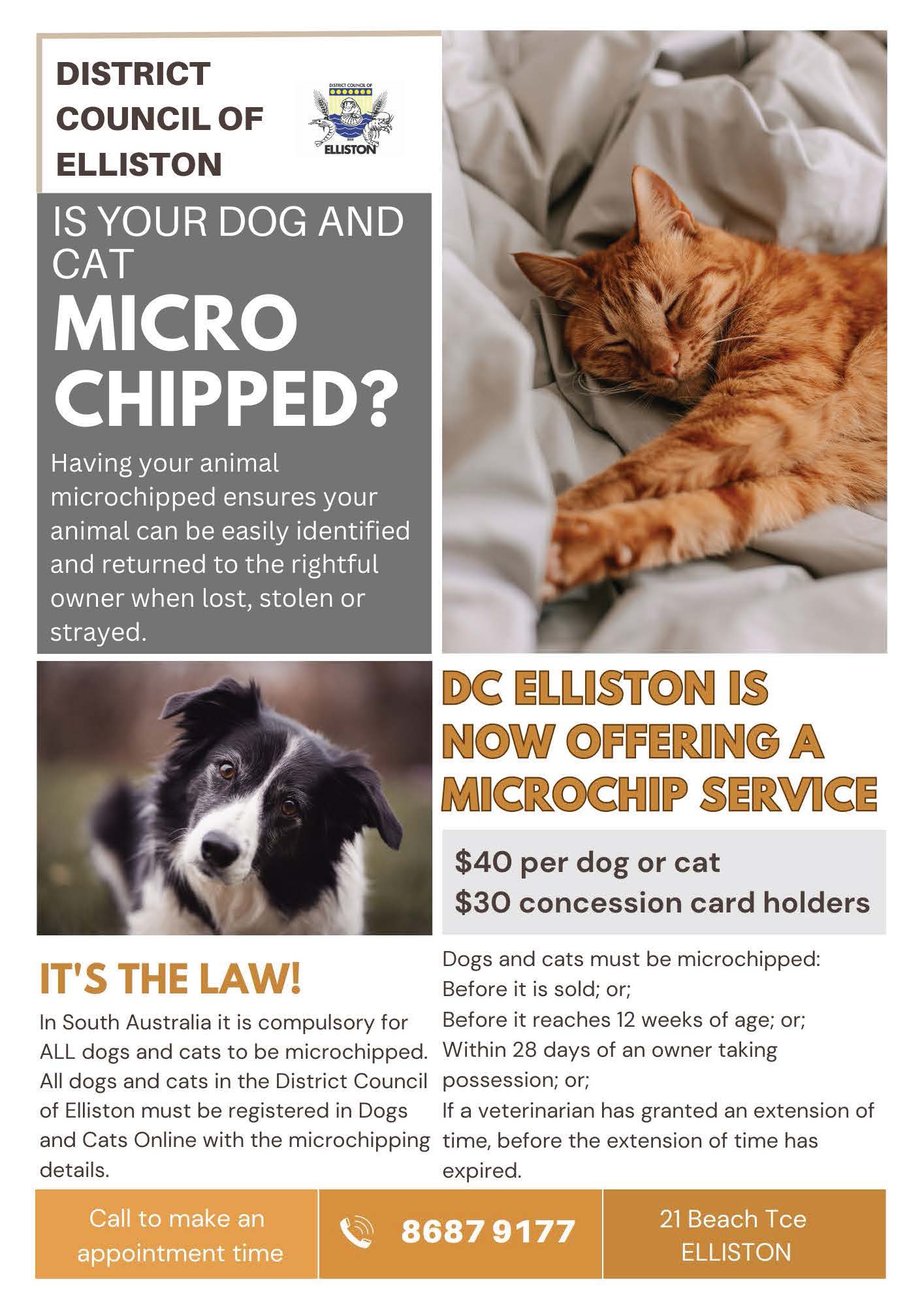
In South Australia, all dogs and cats must be microchipped, desexed and registered in Dogs and Cats Online, the statewide database for dogs, cats, microchip, desexing and breeder registrations. (Some exemptions apply).
All dogs and cats must be microchipped by 12 weeks of age (unless exempted by a vet—see the Dog and Cat Management Board for details).
Your local yet can do this for you or Council now has a certified microchip implanter who can microchip dogs and cats. Call the Council to make an appointment time or your local vet.
Noise Complaints
Dogs are an important part of our local community but dogs that bark excessively can become a source of irritation for neighbours and others. Our best friend can, if it barks continually, become an intrusion and create friction between neighbours.
Approaching the dog’s owner in a neighbourly manner and discussing your concerns with them sometimes easily resolves this type of complaint. The dog’s owner may not realise that the barking is causing an annoyance to other people, and talking about it face-to-face might mean you can resolve it without getting anyone else involved.
If you are not comfortable approaching your neighbour, the Dear Neighbour Your Dog is Barking letter can be sent to your neighbours as a first step to resolve the issue.
If you can’t come to a compromise, and you want to lodge a formal complaint with us, you’ll need to complete a Registration of Animal Bird Noise Complaint and Log.
Dogs Wandering at Large
Dog owners are responsible for ensuring their dog is restrained and under effective control at all times. Dogs found wandering at large can pose risks to people, livestock, and other animals.
If you wish to report a dog wandering at large, please contact Council as soon as possible with as much detail as you can provide, including:
- Location of the dog
- Time and date of the incident
- Photos of the dog/s being reported
- Description of the dog (breed, size, colour, collar, etc.)
- Whether the dog appears aggressive or has caused harm
Report a wandering dog:
- Phone: 8687 9177
- Email: dce@elliston.sa.gov.au
- In person: Visit the Council Office, 21 Beach Terrace, Elliston
If the matter is urgent or involves an immediate threat to safety, please contact Council by phone.
Council Officers will investigate reports and take appropriate action in accordance with the Dog and Cat Management Act 1995.
We encourage all dog owners to ensure their dogs are securely contained within their property at all times.
Dog Attacks
In the event of a dog attack, your priority is to seek medical or veterinary treatment
If your dog is the initiator, restrain it if it’s safe to do so. You have a duty of care to others, so check the welfare of others and their animals involved and support them where possible. Councils must be notified and may investigate.
If you or your dog has been attacked, observe and collect as many details as possible and report it to the council as soon as able. Time is critical factor, especially if the offending dog is wandering on its own, posing a public safety risk. You'll need to provide the following details:
- Date, time and location of the attack
- Description of the offending dog including registration disc or collar details, breed, colour, sex, makings
- Description of the owner male or female, approximate age, hair colour and if possible contact details including name, address, phone number.
- Description of car if the offender drove away with the dog including car registration number, make, model, colour
- Description and photographs of any injuries to you and your pet
- Please keep any copies of any medical certificates or vet/doctors bills as evidence.
It’s important also to take some notes as soon as you can about the incident.
What happens next?
Council investigators may take statements and photographs of any evidence, including injuries, from any involved parties or witnesses. Depending on the severity of the attack, councils can
- issue a warning;
- impose a fine of $315 or if more serious
- take court action.
Council can also impose a 'control order' on the dog and its owner - nuisance, dangerous, menace or destruction order, or leashing/muzzling requirements
Claims for damages (this can also include veterinary care) are addressed as civil matters.
Dangerous dogs
If a council animal management officer has assessed a dog to be potentially dangerous, it will have to wear a collar to identify it. This collar warns others to give the dog space. These collars have yellow and red diagonal stripes. Any dog of any breed or size can be dangerous.

Unless specifically identified below as an off leash area, all roads, footpaths, walking trails, coastal camping areas, public parks, foreshore areas and public spaces within the District Council of Elliston are on leash areas.
This includes, but is not limited to:
- Sheringa Beach and Walker’s Rock Camping Areas
- Millikans Beach
- Talia Beach
- Elliston Wetlands
Dogs must remain on a leash in these areas and be under the effective control of a responsible person at all times.
Off Leash Parks and Areas
Elliston
- Waterloo Bay Recreational Beach (Elliston Boat Ramp to Jetty)
- Clifftop Drive
- Little Bay Beach
Sheringa
- Sheringa Recreational Beach
Venus Bay
- South Head Walking Trail
Port Kenny
- Western Town Parklands
Lock
- Council Land (Between North Terrace and Hitchcock Street)
There are laws which regulate breeding and selling dogs and cats in South Australia. The most significant are set out below. Visit the Dog and Cat Management Board website for further information.
- Breeders and sellers must adhere to the South Australian Standards and Guidelines for Breeding and Trading Companion Animals.
- Breeders intending to sell dogs or cats they have bred must register in Dogs and Cats Online.
- A dog or cat can’t be sold without a microchip.
- Dogs and cats must be desexed by six months of age.
- Any advertisement selling a dog or cat must include the seller and breeders’ contact details and breeder registration number.
- Sellers/breeders must provide specific information to purchasers, eg. seller and breeders’ details; breeders’ Dogs and Cats Online number; vaccination details; desexing details; microchip details; known illnesses or medical conditions; control order information (dogs)
All dogs and cats born after 1st July 2018 must be desexed by a registered veterinary surgeon before it is 6 months of age; or within 28 days after an owner takes possession of a puppy or kitten. Some exemptions can apply, visit the Dog and Cat Management Board website for details. Desexing must only be carried out by a certified Veterinarian.
There are many reasons why pet owners should desex their pets. As well as helping to stop pet overpopulation, the following are some of the other benefits associated with desexing cats and dogs.
Health
- Reduced risk of getting cancer or other diseases of the reproductive organs, such as testicular cancer, prostate cancer/disorders in males, and cystic ovaries, ovarian tumors, acute uterine infections and breast cancer in females, and also other diseases like mammary cancer, perianal tumors and perianal hamias.
- Females can suffer from physical and nutritional exhaustion if continually breeding.
- Desexed pets generally live longer and healthier lives.
Behavioural
- Pets are less prone to wander, fight, and are less likely to get lost or injured.
- Reduces territorial behaviour such as spraying indoors.
- Less likely to suffer from anti-social behaviors. They become more affectionate and become better companions.
- Eliminates “heat” cycles in female cats and their efforts to get outside in search for a mate.
- Eliminates male dogs’ urge to “mount” people’s legs.
Cost
- Reduces the cost to the community of having to care for unwanted puppies and kittens in pounds and shelters.
- No additional food or vet bills for the offspring.
- No need to find homes for unwanted or unexpected litters of puppies or kittens.
- Save money from expensive surgeries from car accidents or fights, which are less likely to occur if your pet doesn’t roam around.
- Dumping puppies and kittens is an ethical cost, as well as being illegal and inhumane.
Myth Busters
- "Male dogs will not lose their manliness."
Like vasectomy in humans’, sex can still be performed, there is just no offspring from the act
- "It's not fair on my animal if I don't let it experience having one litter"
There is no evidence to suggest pets benefit from having one litter before being desexed. Animals are at higher health risk from pregnancy and birth
- "My pets behaviour will change"
Yes! But in a good way! It reduces hormonal fluctuations reducing aggression, unpredictable behaviour, roaming or marking of territories
- "My animal will get fat!"
Desexed animals do not get fat, only being overfed or under exercised will contribute to this
- "Desexing is expensive"
While the procedure will cost you initially, it will save you money in the long run, from unwanted pregnancies, injuries from fighting or roaming or more animals.
We understand the importance of the health and wellbeing pets can provide to our community. Animals provide companionship, affection and fun. People with pets often live longer, healthier lives, with better cardiovascular health, lower blood pressure and lower levels of anxiety.
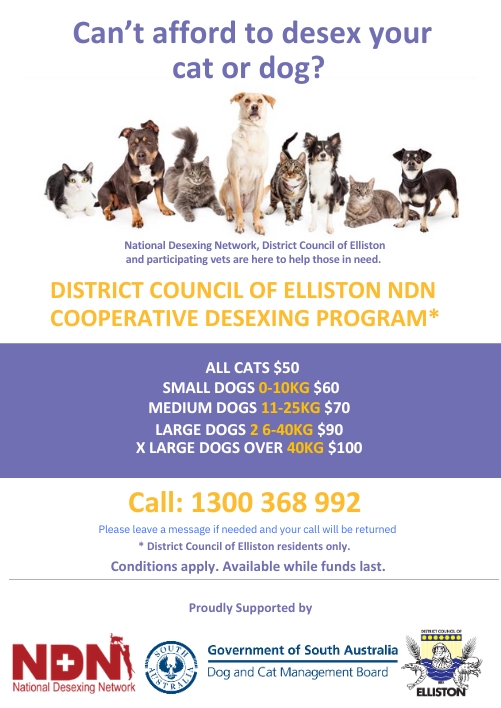
But owning a pet does come with added responsibilities and costs. In South Australia, all dogs and cats must be desexed (exemptions apply to breeding animals, working dogs and medical issues certified by a vet). Mandatory desexing has been introduced to help reduce the number of unwanted litters in the community. The National Desexing Network (NDN) Program was developed to help those in need.
If you are a resident in the District Council of Elliston, and have a current concession card, or are suffering from financial hardship, please call the NDN Ph 1300 368 992, to apply for a reduced rate to desex your animal. Please leave a message for a call back if you are not answered. Your call will be returned! Animals are desexed in Port Lincoln at participating vets, Lincoln Vet Centre and Vets on Eyre.
How does the NDN Program work?
Pet owners call the NDN to check their eligibility. If approved, a desexing voucher will be emailed to the client. Clients then call a participating vet clinic and make an appointment being sure to mention that you have an NDN desexing voucher. Vouchers are valid for one month. Discounted microchipping for $5 is also available but only when the desexing procedure is being carried out.
If you can afford to pay your veterinarian’s normal fees, it is important that you do so. The NDN referral service is designed for pet owners in genuine financial need, and it is unfair to ask veterinarians to reduce reasonable fees for financially secure clients who are simply looking for ‘the best deal’. It is NOT available for intentional breeders of cats or dogs who can recoup the cost of desexing when they sell their animals.
The vets participating in the NDN program receive no subsidies or funding. These vets discount their prices out of goodwill and their commitment to the welfare of Australia’s cats and dogs. Please be polite, show your appreciation, and consider supporting the vets registered with the NDN by visiting them for any other treatments your pet may require.
The prices that are given only include the costs for desexing. If your cat or dog is pregnant, in-season or has undescended testicles, there may be extra cost. Also, any optional extras such as pre-op blood tests, fluids, extra pain relief, an Elizabethan collar, etc. are at your expense. Please ensure you ask the clinic about these additional costs and/or optional services before your appointment, so you avoid unexpected costs.
Call the Council office if you for further information 8687 9177 or go to ndn.org.au
We thank our participating Vet's, NDN and the Dog and Cat Management Board for supporting this important initiative.
Please share this information with anyone that you think may benefit from this.
More helpful tips and information sheets for responsible ownership and happy pets can be found on the Dog and Cat Management Board website - https://dogandcatboard.com.au/